An eCommerce website in Dubai costs between AED 5,000 and AED 75,000+ in 2026. A solid WooCommerce store for a small to mid-size retailer typically costs AED 8,000–25,000 to build, while a fully custom-developed store with unique workflows, ERP integration, or a customer portal commonly runs AED 35,000–120,000+. On top of the build, budget for your trade licence, payment gateway fees, hosting, and Arabic translation if you plan to sell seriously across the Emirates and the wider Gulf.
Dubai shoppers buy online at high rates, expect fast mobile checkout, and increasingly pay in instalments through services such as Tabby and Tamara. This guide compares the two main build routes — WooCommerce and custom development — in dirhams, so you can choose based on your catalogue and growth plans, not guesswork.
The Short Answer: WooCommerce vs Custom at a Glance
| Factor | WooCommerce (WordPress) | Custom development (Laravel / Next.js) |
|---|---|---|
| Typical build cost (AED) | 8,000 – 25,000 | 35,000 – 120,000+ |
| Typical timeline | 4–8 weeks | 3–6 months |
| Product catalogue | Best up to a few thousand SKUs | Unlimited / complex catalogues |
| Checkout | Proven, extensible checkout | Fully tailored checkout and pricing logic |
| Arabic + English (RTL) | Fully supported | Fully supported, more build effort |
| Tabby / Tamara / Apple Pay | Plugins and gateway integrations | Custom API integration |
| ERP / POS integration | Available via plugins/APIs | Built exactly to your systems |
| Maintenance cost | Lower | Higher, needs a development partner |
| Best for | Most retailers, D2C brands, B2B catalogs | Marketplaces, subscriptions, unique workflows |
eCommerce Build Costs in the UAE by Store Type (2026)
| Store type | Typical 2026 market range (AED) | What is included |
|---|---|---|
| Starter online store (under 50 products) | 5,000 – 10,000 | Template-based design, standard checkout, COD + card payments |
| Growing WooCommerce store (50–1,000 products) | 10,000 – 25,000 | Customised design, Arabic/English, Tabby/Tamara, shipping rules |
| Advanced WooCommerce / B2B store | 25,000 – 50,000 | Trade pricing, quote requests, ERP/accounting integration |
| Custom eCommerce web application | 35,000 – 120,000+ | Bespoke storefront, portal, subscriptions or marketplace features |
| Marketplace (multi-vendor) | 75,000 – 200,000+ | Vendor onboarding, commissions, payouts, dispute flows |
Market ranges, 2026, Dubai and Abu Dhabi providers and experienced remote partners. Large local agencies frequently quote above these ranges.
UAE-Specific Costs Foreign Guides Never Mention
Trade licence
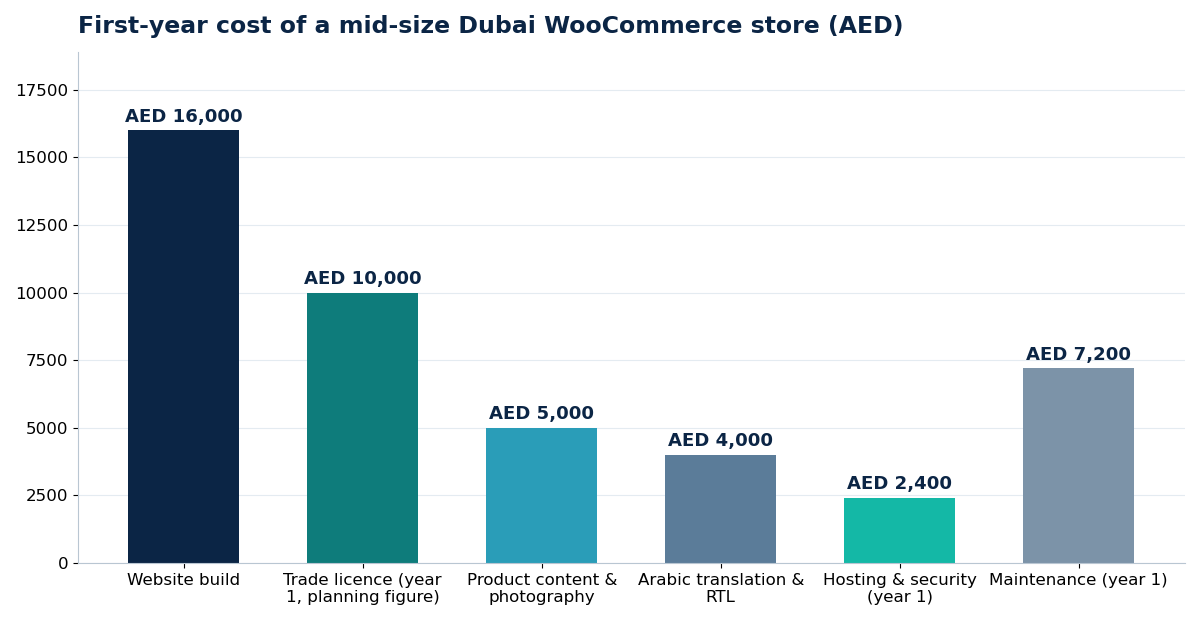
You cannot legally sell online in the UAE without a licence. Mainland and free-zone eCommerce licences vary widely by authority and activity — as a planning figure, businesses commonly budget AED 5,000–15,000 for the first year for a basic eCommerce licence setup, before office or visa costs. Confirm current fees with your chosen licence authority or formation agent, as packages change frequently.
Payment gateways
UAE merchants typically use providers such as Telr, PayTabs, Stripe (where available for their licence type), Network International, or CCAvenue. Budget for setup/annual fees where applicable, plus per-transaction commissions that commonly sit around 2.5%–3.5% + a small fixed fee. Adding instalment options such as Tabby and Tamara has become close to essential for fashion, beauty, electronics, and furniture in the Emirates.
Arabic and RTL
A bilingual store is not a translation line item to skip. Proper Arabic support means RTL layout testing, Arabic product content, and Arabic checkout and email flows. Budget AED 2,000–6,000 for professional translation and RTL adjustments on a mid-size store, more for large catalogues.
Delivery and logistics
Same-day and next-day delivery expectations in Dubai and Abu Dhabi mean integrating couriers or aggregators, cash-on-delivery handling, and clear shipping zones for all seven Emirates — plus GCC shipping if you sell into Saudi Arabia and Kuwait.
When WooCommerce Is the Right Choice
Choose WooCommerce if you sell physical or digital products with standard pricing, want to launch in weeks rather than months, and want your own team to manage products without a developer. It powers stores from ten products to thousands, integrates with the gateways UAE customers expect, and keeps your running costs predictable. Preparing your catalogue properly saves real money here — organising SKUs, prices, SEO fields, and image data in advance with a structured template such as the WooCommerce Product Upload Template removes hours of billable data-cleaning from a project.
Before launch, compress product photography so category pages stay fast on mobile data — the free Image Compressor and Image to WebP Converter handle this in the browser with no uploads to third-party servers.
When Custom Development Is Worth the Extra Dirhams
Choose a custom Laravel or Next.js build if your store needs something WooCommerce was not designed for: multi-vendor marketplace logic, complex B2B pricing per customer group, subscription or rental flows, a customer portal tied to an ERP, or performance targets at very high traffic. Custom development costs more up front and needs an ongoing development partner for maintenance, but it removes the ceiling on what the store can become — and avoids an expensive rebuild when a plugin-based store hits its limits in year two.
A practical middle path many UAE businesses take: launch on WooCommerce to validate demand, then commission custom development for the specific workflows that outgrow it.
WooCommerce or Custom? A Quick Decision Guide
Work through the five situations below and count how many describe your store. The count — not fashion, and not the cheapest quote — should drive the platform decision.
| If your store needs… | What it signals | Recommended route |
|---|---|---|
| Multi-vendor / marketplace features | Sellers, commissions and split payouts are core logic, not a bolt-on | Custom development (or WooCommerce with a serious marketplace build) |
| Different prices for different customer groups | B2B or tiered pricing rules beyond standard sale prices | WooCommerce can handle simple tiers; complex rules point to custom |
| Subscriptions, rentals or complex booking logic | Recurring billing and availability rules that plugins handle unevenly | Start on WooCommerce only if a proven plugin covers your exact flow — otherwise custom |
| Deep connection to a custom ERP system | Two-way sync of stock, orders and pricing with your own system | Custom development, or WooCommerce with a custom integration layer |
| Very high traffic from day one | Performance targets that shared plugin stacks struggle to meet | Custom development with performance engineered in |
Score your store:
- 0–1 situations apply: WooCommerce is likely the right fit — launch faster and cheaper, and spend the savings on marketing.
- 2–3 situations apply: Start on WooCommerce, and plan custom work for exactly those features as a phase two.
- 4–5 situations apply: Talk to a developer about a custom build before you spend money on a platform you will outgrow within a year.
Ongoing Annual Costs for a UAE Online Store
| Ongoing item | Typical annual range (AED) | Notes |
|---|---|---|
| Licence renewal | 5,000 – 15,000 | Depends on authority and activities |
| Hosting (UAE-friendly performance) | 1,200 – 4,500 | Cloud/VPS recommended for stores |
| Maintenance & updates | 4,800 – 18,000 | WooCommerce at low end, custom at high end |
| Payment gateway fees | ~2.5% – 3.5% per transaction | Plus any annual gateway fee |
| Marketing / SEO | 2,000 – 8,000 / month (optional) | Google Ads, social, content |
Conclusion
For most Dubai and Abu Dhabi retailers in 2026, a well-built WooCommerce store at AED 8,000–25,000 is the fastest, safest route to selling online, with Arabic support and Tabby/Tamara built in. Reserve AED 35,000+ custom development for marketplaces, complex B2B pricing, and ERP-driven workflows where it genuinely pays for itself.
Asad Webs builds WooCommerce stores and custom Laravel and Next.js eCommerce applications for Gulf businesses, with bilingual layouts, local payment integrations, and clear fixed scopes. Share your product count and the features you need, and get a dirham-accurate breakdown before you commit. More practical guides are coming to the Asad Webs blog.
Frequently Asked Questions
How much does a WooCommerce store cost in Dubai?
A professionally built WooCommerce store in Dubai typically costs AED 8,000–25,000 in 2026, depending on product count, custom design, Arabic support, and integrations such as Tabby, Tamara, and courier APIs. Starter template stores can begin near AED 5,000.
Do I need a trade licence to sell online in the UAE?
Yes. Selling online in the UAE requires a trade licence with an eCommerce activity, issued either on the mainland or through a free zone. Budget roughly AED 5,000–15,000 for the first year as a planning figure and confirm current fees with your licence authority.
Should my UAE store be in Arabic as well as English?
For most consumer stores, yes. A bilingual Arabic/English store with proper RTL layout widens your audience across the Emirates and the GCC, and Arabic product pages also open up Arabic search traffic that English-only competitors miss.
Which payment methods should a Dubai online store offer?
At minimum: Visa/Mastercard via a UAE gateway, Apple Pay, and cash on delivery if your margins allow it. Instalment services such as Tabby and Tamara are now standard expectations in categories like fashion, beauty, and electronics.
WooCommerce or custom development — which is cheaper over three years?
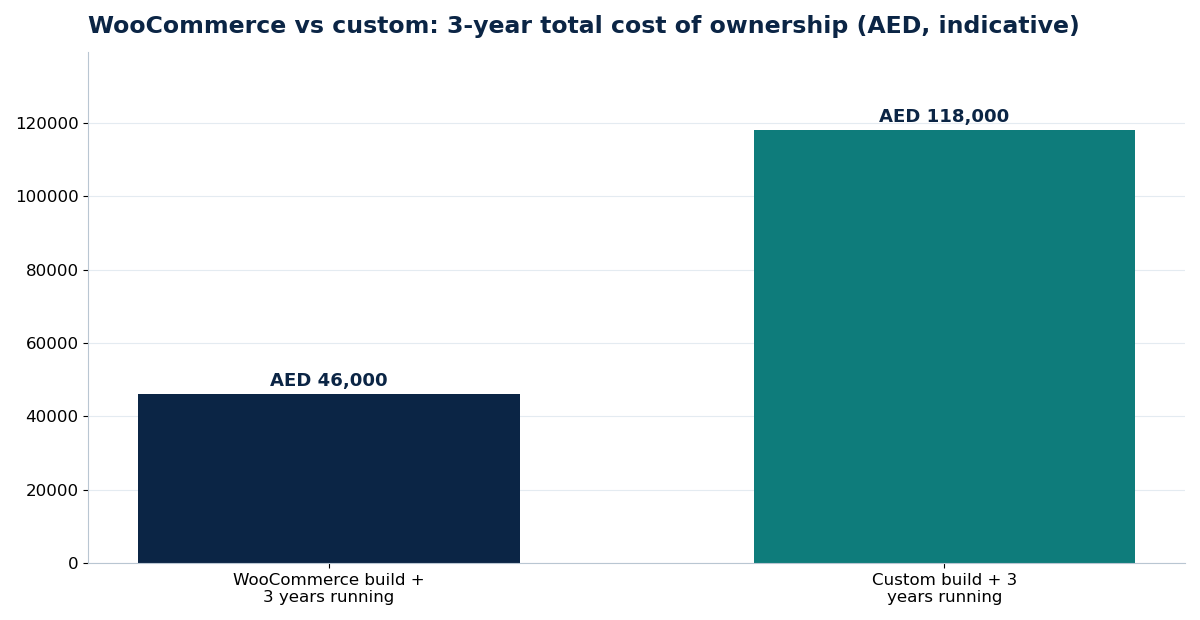
WooCommerce, by a wide margin for standard stores: lower build cost and lower maintenance. Custom development only wins financially when its unique features — marketplace logic, complex B2B pricing, deep ERP integration — generate revenue a plugin-based store cannot.
Be the first to share a useful question or thought.