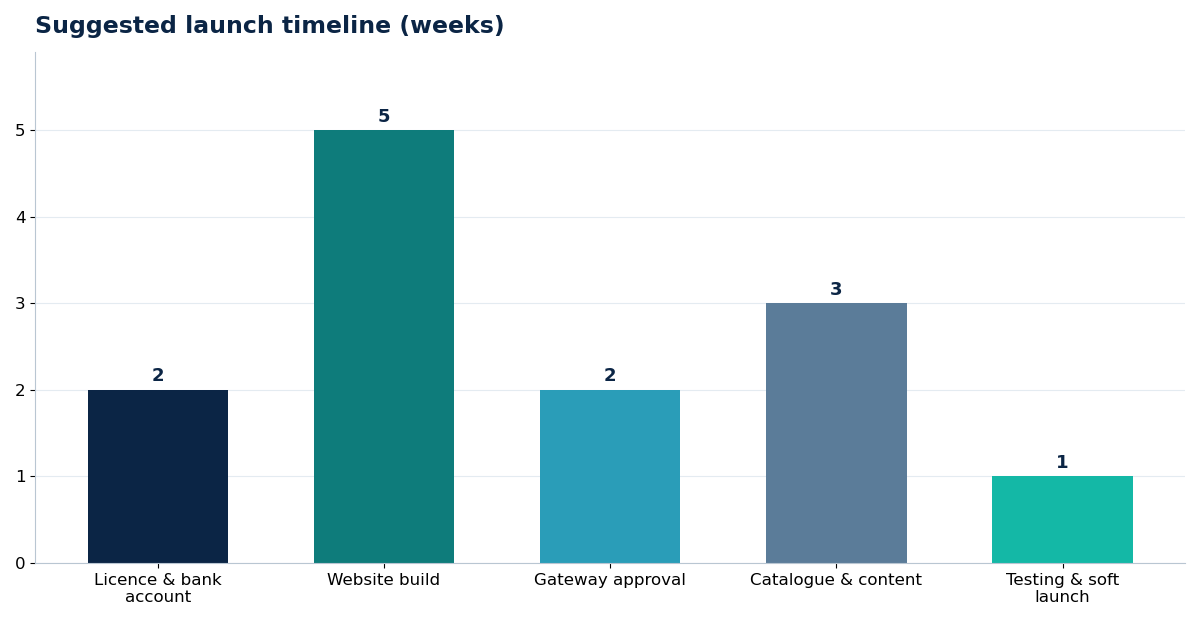
To start an online store in the UAE in 2026 you need five things in place: a trade licence with an eCommerce activity (mainland or free zone), a business bank account, a website — typically AED 5,000–25,000 for WooCommerce or AED 35,000+ for custom development — payment gateways offering cards, Apple Pay, and instalments through Tabby or Tamara, and a delivery setup covering your target Emirates. Most founders can go from licence to first sale in 4–8 weeks if the product catalogue is prepared early. This guide walks through each step in order, with realistic dirham costs.
The UAE is one of the most attractive eCommerce markets in the region: high smartphone use, strong purchasing power in Dubai and Abu Dhabi, and customers who expect a store to feel as polished as the global platforms they already buy from. The good news is the path is well-trodden. Here is the exact sequence.
Step 1: Choose and Get Your Trade Licence
You cannot legally sell online in the UAE without a trade licence that covers eCommerce activity. Your two main routes:
| Route | Typical first-year planning figure (AED) | Notes |
|---|---|---|
| Free zone eCommerce licence | 5,000 – 12,000 | Often no office required; check rules for selling on the mainland — a distributor/local agent or additional permits may apply for direct mainland sales |
| Mainland (DED) eCommerce licence | 8,000 – 15,000+ | Sell anywhere in the UAE directly; office/ejari costs may apply |
| Home-based / instant licences (eligible activities & nationalities) | Lower, varies | Availability and eligibility change; verify with the issuing authority |
Planning figures only, 2026. Packages bundle different items (visas, office, activities) — compare what is included, not just the headline.
Choose based on where your customers are, whether you need visas and a physical presence, and whether you plan to open a shop later. Many online-only founders start in a free zone and upgrade as they grow.
Step 2: Open a Business Bank Account
Gateway providers and marketplaces require a UAE business bank account in the licence name. Account opening for new eCommerce businesses can take days to several weeks depending on the bank and your activity, so start this immediately after the licence issues — it is the most common hidden cause of launch delays.
Step 3: Build the Website
For most new UAE stores, WooCommerce is the sensible start: AED 8,000–25,000 for a professionally built, bilingual store, launched in 4–8 weeks, with your team able to manage products. Choose custom development (AED 35,000+) only if you need marketplace features, complex B2B pricing, subscriptions, or deep ERP integration from day one.
Non-negotiables for a UAE store build:
- Arabic + English with proper RTL layout — not a translated afterthought
- Mobile-first design — most Gulf shopping happens on phones
- Fast product pages — compress every image before upload with the free Image Compressor or convert them with the Image to WebP Converter
- Clear delivery, returns, and contact pages with your licence details displayed — UAE customers check for legitimacy before paying a new store
Prepare your catalogue before the build starts — SKU, Arabic and English names, prices, stock, image files — in one structured sheet such as the WooCommerce Product Upload Template. Founders who do this launch weeks faster.
Step 4: Set Up Payments — Cards, Apple Pay, Tabby and Tamara
UAE shoppers expect choice at checkout. Plan for:
- Cards via a UAE gateway — providers commonly used include Telr, PayTabs, Network International, and CCAvenue; Stripe is available to eligible UAE businesses. Expect onboarding documents (licence, bank details, website with policies live) and per-transaction fees commonly around 2.5%–3.5% plus any annual fee.
- Apple Pay and Google Pay — enable them; mobile wallet checkout measurably reduces friction on phones.
- Instalments with Tabby and Tamara — buy-now-pay-later is now a mainstream expectation in the Emirates, especially in fashion, beauty, electronics, and furniture. Both services pay you upfront and carry the customer credit risk; you pay a higher commission per order than cards, in exchange for higher conversion and basket sizes. Apply early — approval requires a live, policy-complete store.
- Cash on delivery (COD) — still used by a segment of UAE customers. It builds trust with first-time buyers but adds failed-delivery and cash-handling costs; many stores phase it down as their brand matures.
Important sequencing detail: gateways approve live websites with visible prices, policies, and contact details — so payment setup overlaps the end of the build, not the beginning.
Step 5: Sort Delivery Before You Sell Anything
Delivery is part of your product in the Emirates. Same-day is offered in Dubai by premium couriers; next-day is the realistic standard most customers expect.
- Courier partners: local and regional couriers and aggregators (for example Aramex, Fetchr/iMile-type networks, and aggregator platforms such as Shipa Delivery or Zajel — verify current services) let you compare rates per Emirate.
- Zones and pricing: set explicit rates for Dubai, Abu Dhabi, Sharjah and the Northern Emirates, plus a free-shipping threshold that protects your margin.
- GCC expansion: Saudi Arabia and Kuwait are natural second markets; confirm customs and COD handling with your courier before advertising there.
- Returns: publish a clear returns process and cost it in — easy returns are a conversion feature, not just an expense.
Step 6: Launch Checklist and First Sales
Work through a final pre-launch pass: test orders end-to-end (including a refund), Arabic checkout proofread by a native speaker, delivery zones tested with real addresses in at least three Emirates, and analytics installed. For the website side, a structured pass with the WordPress Business Website Launch Checklist catches the unglamorous items — favicons, 404 pages, metadata — that undermine a new store's credibility. Check every page's title and description with the free Meta Tag Analyzer.
Then launch in this order: soft launch to your existing audience (Instagram/WhatsApp lists convert first in the Gulf), collect the first reviews, then scale paid ads once delivery and returns have survived real orders.
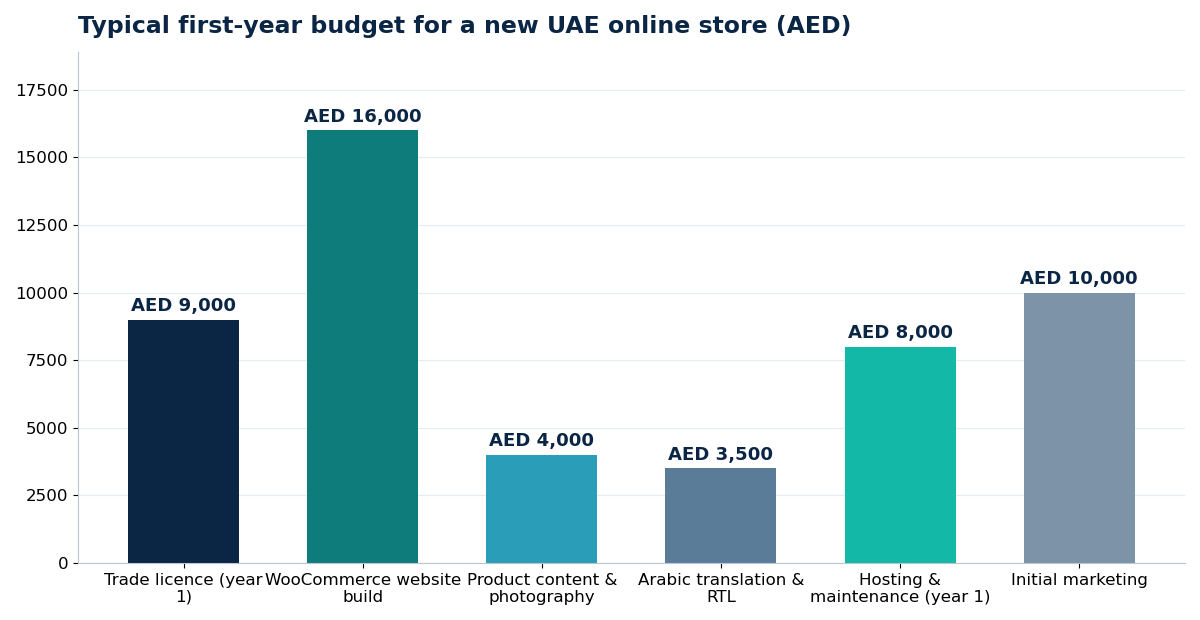
Total Cost Summary: Year One
| Item | Indicative AED range |
|---|---|
| Trade licence (year 1) | 5,000 – 15,000 |
| Website build (WooCommerce) | 8,000 – 25,000 |
| Content, photography, Arabic translation | 4,000 – 10,000 |
| Hosting + maintenance (year 1) | 6,000 – 12,000 |
| Gateway setup/annual fees | 0 – 2,500 (plus per-transaction %) |
| Launch marketing | 5,000 – 20,000 |
| Indicative year-one total | ~28,000 – 84,500 |
Excludes inventory, warehousing, salaries, and per-transaction commissions.
Launch Readiness Checklist: Score Your Store
Readiness is not a feeling — it is a short list of finished items. Go through the seven steps below, count how many are genuinely complete for your store, and use the scoring guide underneath.
- Trade licence with eCommerce activity issued — the legal foundation everything else (bank account, gateways) depends on.
- Business bank account open — gateway payouts and Tabby/Tamara settlement need it.
- Website live in Arabic + English, with RTL tested — not "almost ready": live, tested on mobile, in both languages.
- Card gateway approved and Apple Pay switched on — approval received, not just applied for.
- Tabby / Tamara application submitted — instalments are a major conversion lever in the UAE; do not leave this to launch week.
- Courier rates set for every Emirate you ship to — including the delivery promises and cut-off times shown on the site.
- Returns policy published and a test order placed — a full test purchase, including a refund, before a real customer tries it.
Score your store:
- 6–7 complete: You are launch-ready. Set a date, announce it, and start selling.
- 4–5 complete: Close — finish the remaining payment and delivery items first; they are the ones that stall launches.
- 0–3 complete: Foundations first. Work the steps in the order this article sets out, and do not spend on marketing yet.
Conclusion
Starting an online store in the UAE in 2026 is a defined, 4–8 week process: licence, bank account, a bilingual WooCommerce or custom website, Tabby/Tamara-ready payments (cards, Apple Pay, instalments), and Emirate-by-Emirate delivery. Budget roughly AED 28,000–85,000 for year one excluding stock, and do the steps in order so gateway approvals never stall your launch.
When you reach Step 3, Asad Webs builds UAE stores with Arabic RTL design, local gateway and Tabby/Tamara integration, and fixed written scopes. Bring your licence and product list — we will give you a launch date, not a guess. More guides are on the Asad Webs blog and practical templates in the shop.
Frequently Asked Questions
How long does it take to start an online store in the UAE?
Typically 4–8 weeks: 1–3 weeks for licence and bank account (run in parallel), 4–8 weeks for a WooCommerce build, with gateway approval overlapping the final build stage. Prepared product data is the biggest time-saver.
Can I sell online in the UAE without a licence?
No. Selling commercially online requires a UAE trade licence with eCommerce activity. Social-media selling without one risks fines and account closure, and payment gateways will not onboard you.
How do I add Tabby or Tamara to my store?
Apply directly to Tabby or Tamara once your store is live with prices, policies, and contact details visible. After approval, integration is via plugin or API on WooCommerce and custom builds. You pay a commission per instalment order; the provider pays you the order value upfront, minus their fee, per their terms.
Which is better for a new UAE store: free zone or mainland licence?
It depends on how and where you sell. Free zone licences are often cheaper and simpler for online-only businesses, while mainland licences let you sell directly across the UAE without intermediaries. A formation agent can confirm the current rules for your activity — packages and conditions change.
Do I need an Arabic version of my store?
For most consumer stores, yes. An Arabic storefront with correct RTL design widens your market across the Emirates and the GCC and captures Arabic search traffic your English-only competitors ignore.
Be the first to share a useful question or thought.