
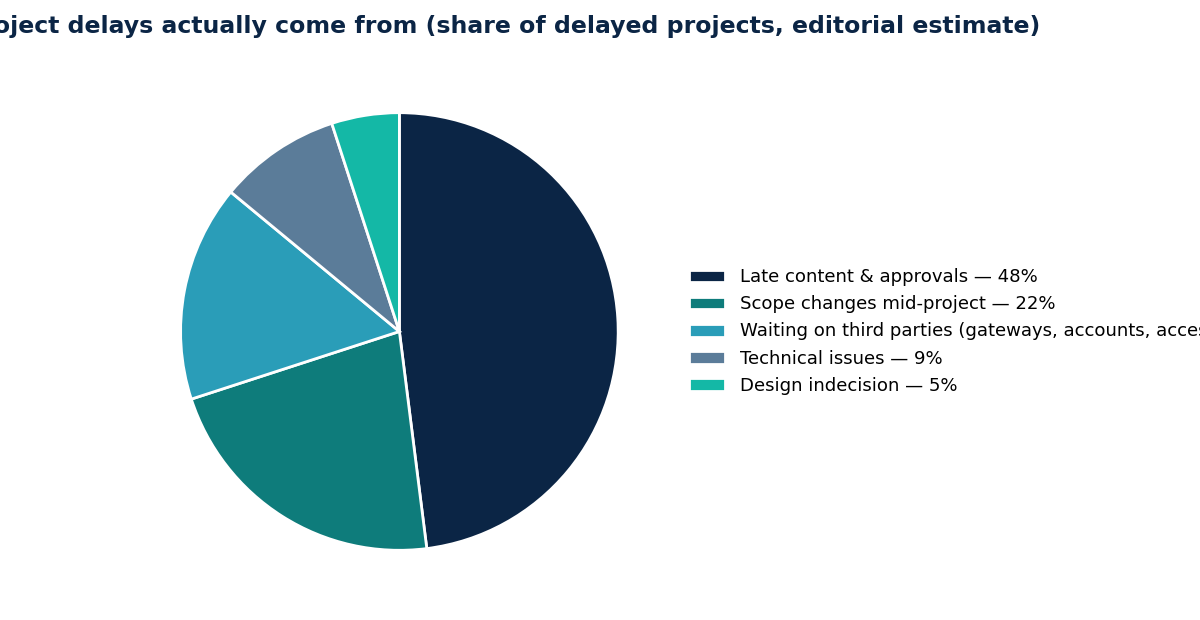
A typical business website takes 3 to 8 weeks to build in 2026 — about 2–4 weeks for a small 5-page site with content ready, 4–8 weeks for most custom business websites, 6–12 weeks for eCommerce, and 3–6 months for a custom web application. The surprising truth: design and development are rarely the bottleneck. Around half of all project delays come from content — copy, photos, product data, and approvals arriving late. This guide gives you the honest phase-by-phase timeline, explains exactly what happens in each phase, flags the delays that actually happen, and shows you how to be the client who launches on time.
If you are planning around a trade show, a seasonal peak, or a funding announcement, work backwards from this article: pick your launch date, subtract the timeline for your site type below, then subtract two buffer weeks. That date is when you need to start — and, just as importantly, when your content needs to exist.
The Timeline by Website Type
| Website type | Realistic total timeline | Build phases involved |
|---|---|---|
| Landing page | 1 – 2 weeks | Discovery (light), design, build, launch |
| Small business site (5–10 pages) | 2 – 4 weeks | All standard phases |
| Custom business site (10–25 pages) | 4 – 8 weeks | All phases, more design & review rounds |
| eCommerce store | 6 – 12 weeks | All phases + catalogue, payments, delivery setup |
| Custom web app / portal | 3 – 6+ months | Extended discovery, development sprints, testing |
Phase by Phase: What Actually Happens
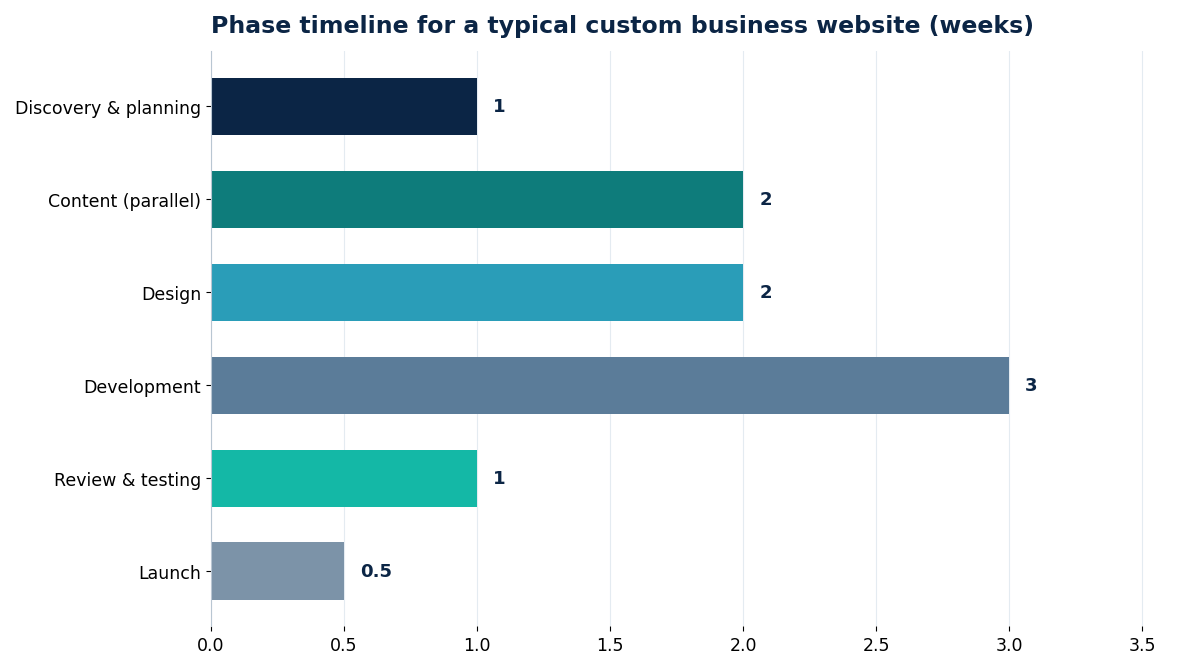
Phase 1 — Discovery and planning (3–5 working days)
Goals, audience, competitor scan, sitemap, and a written scope with a page list and feature list. This short phase prevents the most expensive sentence in web projects — "can we just add…" — from arriving in week five. Deliverable: signed scope and sitemap.
Phase 2 — Content (1–3 weeks, runs in parallel)
Copy for every page, photography, logos and brand files, product data for stores. This phase belongs mostly to you, the client, and it is where timelines live or die. Professional copywriting adds cost but removes the single biggest delay risk; if you write your own copy, start the day the scope is signed, not when design finishes. Two free helpers: keep drafts at a sensible keyword balance with the Keyword Density Checker, and plan every page's title and description in advance with the Website SEO Metadata Worksheet.
Phase 3 — Design (1–2 weeks)
Homepage concept first, feedback round, then inner-page designs using your real content (or realistic drafts). One consolidated round of feedback from one decision-maker takes days; feedback from five people across three rounds takes weeks. Deliverable: approved designs for desktop and mobile.
Phase 4 — Development (1–3 weeks; 4–8 for eCommerce/apps)
The site is built on a private staging link: CMS setup (WordPress for most business sites), responsive build, forms, maps, analytics, and integrations. For stores, add catalogue import, payment gateway configuration and test transactions, shipping rules, and tax setup. For Laravel/Next.js builds, development runs longer and in visible sprints. Deliverable: a complete staging site you can click through.
Phase 5 — Review, testing, and revisions (1 week)
You review the staging site against the scope: content proofread, links, forms tested end-to-end, checkout tested with real payment methods in test mode, speed checks, and cross-device testing. Compress any heavy images the content phase produced with the Image Compressor and convert heroes with the Image to WebP Converter. Deliverable: one consolidated change list, completed and re-tested.
Phase 6 — Launch (2–3 working days)
DNS and hosting cutover, SSL, redirects from any old pages, sitemap submission, final metadata verification with the Meta Tag Analyzer, and a post-launch smoke test. A structured pass using the WordPress Business Website Launch Checklist keeps this phase boring — in launch week, boring is good.
The Five Real Causes of Delay — and Their Fixes
- Content isn't ready. Fix: content starts in Phase 1, in parallel, with a named owner and a hard date.
- Too many approvers. Fix: one decision-maker collects all internal feedback into a single list per round.
- Scope creep. Fix: new ideas go on a Phase-2 list, priced and scheduled after launch — the site ships on time and still gets the feature.
- Third parties. Payment gateway approvals, registrar access, and old-developer handovers stall builds. Fix: gather logins, DNS access, and gateway documents in week one.
- Feedback by drip. One change a day for two weeks costs more calendar than a full review day. Fix: schedule your review sessions in the project plan like meetings.
Can It Be Done Faster?
Yes, with honest trade-offs. A template-based build with finished copy can launch in 1–2 weeks. What you give up is distinctiveness and depth, not legitimacy. Conversely, beware any promise of a custom 25-page site "in 5 days": design, build, and testing can be compressed, but approvals and content cannot — the corners being cut are usually SEO setup, testing, and mobile polish, which you pay for later. A phased launch is the smarter acceleration: core pages live in week 4, secondary pages and features in the weeks after, revenue and rankings starting earlier.
Launch-Date Estimator: Worked Examples
You cannot pick a launch date from a calendar widget — but you can estimate one in about a minute. Every professional timeline starts from a planning estimate for the website type, then adjusts for the single biggest variable: whether your content is ready.
| Website type | Typical range | Planning estimate | If your content is ready | If your content is NOT ready |
|---|---|---|---|---|
| Small business site | 2–4 weeks | 3 weeks | Launch in about 3 weeks | Launch in about 5 weeks |
| Custom business site | 4–8 weeks | 6 weeks | Launch in about 6 weeks | Launch in about 8 weeks |
| eCommerce store | 6–12 weeks | 9 weeks | Launch in about 9 weeks | Launch in about 11 weeks |
| Custom web application | 3–6 months | 20 weeks | Launch in about 20 weeks | Launch in about 22 weeks |
How to estimate yours: find your website type in the table and take its planning estimate. If your copy, photos and product data are not finished, add two weeks — unfinished content is the delay this article keeps coming back to. Then count that many weeks forward from your start date, and treat the result as a window, not a promise: gateway approvals, feedback rounds and holidays all eat buffer. If the date matters (a trade show, a season, a campaign), work backwards from it and start the content this week.
Conclusion
Plan on 4–8 weeks for a custom business website, 6–12 weeks for eCommerce, and 3–6 months for a custom application in 2026 — and start your content the week you sign, because that, not coding, is what decides your launch date. A written scope, one approver, and a disciplined launch checklist turn a hopeful estimate into a real date.
Asad Webs works to a published phase plan like this one on every WordPress, WooCommerce, Laravel, and Next.js project, with a staging link you can watch progress on. Tell us your deadline and your pages — we will tell you honestly whether it fits, and what a phased launch would look like if it doesn't. More planning guides live on the Asad Webs blog.
Frequently Asked Questions
How long does it take to build a small business website?
Two to four weeks when content is ready: roughly one week for planning and design, one to two for development, and a few days for review and launch. Unfinished copy is the most common reason it stretches to six.
How long does an eCommerce website take to build?
Six to twelve weeks for most stores. Beyond the standard phases, catalogue preparation, payment-gateway approval, shipping and tax configuration, and checkout testing add real time — starting product data early is the biggest accelerator.
Can a website be built in one week?
A simple landing page or small template-based site, yes — if copy, images, and approvals are ready on day one. A custom multi-page website in a week means testing and SEO setup are being skipped, which usually costs more to fix than it saves.
What delays website projects the most?
Late content and approvals cause roughly half of delays, followed by mid-project scope changes and waiting on third parties such as payment gateways and account access. All three are preventable with a week-one checklist and a single decision-maker.
When should I start if I need a website for a specific date?
Work backwards: subtract your site type's timeline, then add two buffer weeks. For an eight-week custom site tied to a fixed event, starting ten weeks out is the realistic minimum — and your content work should start the same week as the project.
Be the first to share a useful question or thought.