Website maintenance in the USA typically costs $50 to $300 per month for a small business in 2026. If you maintain the site yourself, expect $20–$80 per month in tools and your own time; a professionally managed WordPress site usually lands at $100–$250 per month; and an eCommerce store commonly runs $300 to $1,500+ per month because orders, payments and customer data raise the stakes. These are indicative market ranges, not quotes — what you actually pay depends on your site type, how often content changes, and how much risk a broken or hacked site would create for your business. This guide breaks down what maintenance includes, what each site type pays, and how to choose the right level without overpaying.
Note the difference from build cost: building a website is a one-time project (we covered it in our guide to how much a custom website costs in the USA), while maintenance is the ongoing work that keeps that investment secure, fast and accurate. Skipping it doesn't make the cost disappear — it converts a predictable monthly fee into unpredictable emergencies.
What Website Maintenance Actually Includes
| Task | What it covers | Typical frequency |
|---|---|---|
| Software and plugin updates | WordPress core, theme and plugin updates, tested so an update doesn't break the layout | Weekly to monthly |
| Backups | Full site and database backups stored off-site, with a restore actually tested | Daily for stores, weekly for brochure sites |
| Security | Firewall, malware scanning, login protection, and cleanup if something gets through | Continuous / monthly scans |
| Uptime monitoring | Automatic alerts within minutes if your site goes down, so it isn't discovered by a customer | 24/7 |
| Small content edits | Text changes, new photos, price updates, a new page section — the small jobs you'd otherwise postpone | Monthly allowance (often 30–120 minutes) |
| Performance checks | Speed tests, broken-link scans, form and checkout testing | Monthly to quarterly |
| Reporting | A plain-English summary: what was updated, site health, traffic highlights | Monthly |
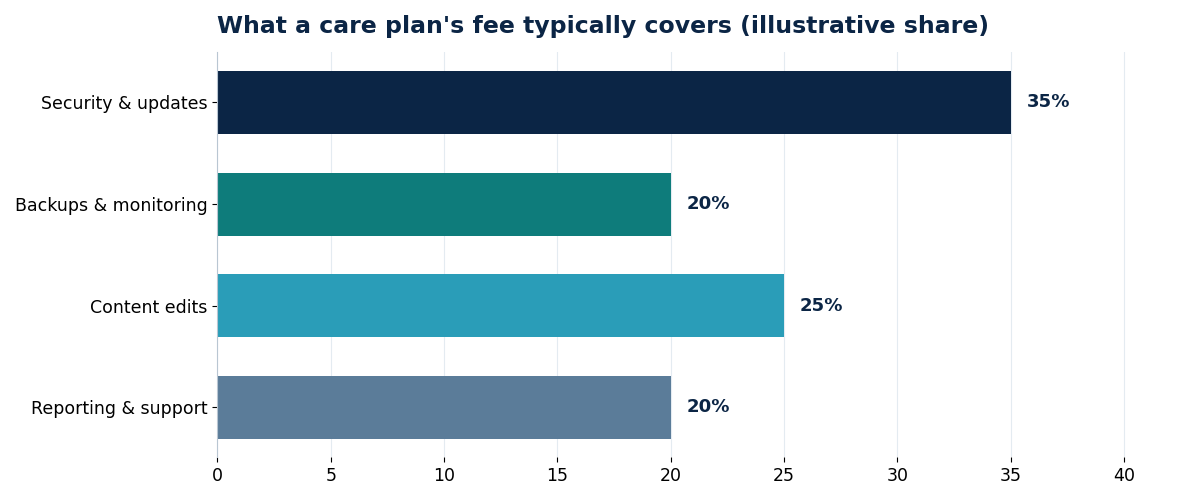
What a care plan's fee typically covers, as an illustrative split: security and updates are the biggest share, followed by the content edits owners actually notice. Plans differ — always compare the task list, not just the price.
Maintenance Cost by Website Type
| Website type | DIY cost / month | Managed plan / month | Why |
|---|---|---|---|
| Brochure site (5–10 pages, rarely changes) | $20 – $40 | $50 – $100 | Few moving parts; updates and backups are the main need |
| WordPress business site (blog, forms, bookings) | $40 – $80 | $100 – $250 | Plugins multiply update and testing work; content changes monthly |
| WooCommerce / eCommerce store | $80 – $150 (plus your time) | $300 – $1,500+ | Downtime and failed checkouts cost sales directly; daily backups and order-flow testing |
| Custom site or web app (Laravel / Next.js) | Not realistic for most owners | $500 – $2,000+ (support retainer) | Needs a developer: dependency updates, server care, feature fixes |
Indicative US market ranges, 2026. DIY figures count tools and subscriptions only — your hours are the hidden cost.
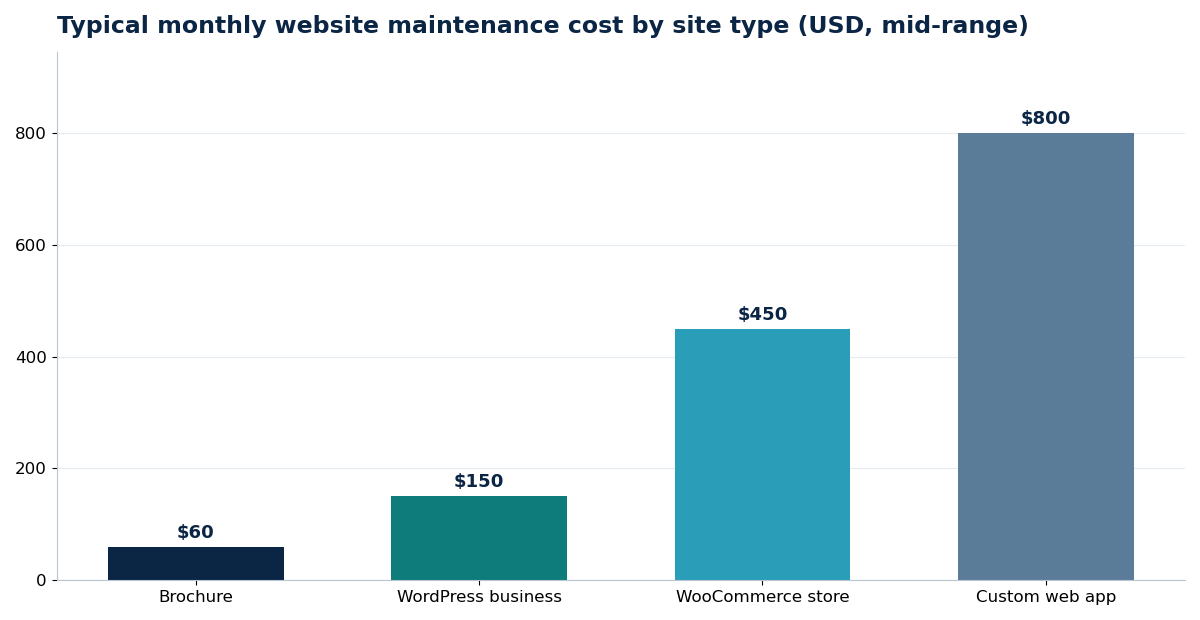
What That Adds Up to Over a Year
| Plan level | Monthly | Annual total | Typical fit |
|---|---|---|---|
| DIY basics (hosting tools, backup plugin, your time) | $30 | $360 | Hobby and very small brochure sites |
| Standard care plan | $150 | $1,800 | Most small business WordPress sites |
| eCommerce care plan | $450 | $5,400 | Stores taking orders every day |
| Custom app support retainer | $800 | $9,600 | Portals, SaaS and custom web applications |
Framed annually, the decision is simpler: a standard care plan costs less per year than most businesses spend on a single day of lost trading or one emergency cleanup. That doesn't make every plan good value — it makes the task list worth reading before you sign.
DIY vs Freelancer vs Agency: Who Should Maintain Your Site?
| Option | Typical cost | Strengths | Watch out for | Best for |
|---|---|---|---|---|
| DIY (you, with tools) | $20–$80/mo + your time | Cheapest in cash; you learn your own site | Updates get skipped when you're busy; backups often untested; security is on you | Simple sites and owners who genuinely enjoy the technical side |
| Freelancer | $75–$300/mo | Personal, flexible, often the same person who built the site | Availability during holidays or their busy periods; ask who covers emergencies | Small business sites with a trusted builder |
| Agency / care-plan provider | $100–$1,500+/mo | Documented process, monitoring tools, cover when one person is away | Check the task list and response times, not just the brand name | Stores and businesses where downtime is expensive |
The Real Cost of NOT Maintaining Your Site
An unmaintained website rarely fails all at once; it decays. Plugins age, and outdated plugins are one of the most common ways small sites get compromised. A hacked site can mean cleanup fees, a warning label in search results, lost customer trust, and days of downtime — a combination that can easily cost more than several years of care-plan fees. Even without an attack, neglect shows up as broken contact forms nobody noticed, pages slowing down until visitors leave, and content so outdated it quietly costs you enquiries. Search engines reward sites that stay fast, secure (HTTPS) and current, so maintenance is also what protects the rankings your content earned. None of this is guaranteed to happen to you — but maintenance is priced like insurance because it behaves like insurance: cheap in advance, expensive in arrears.
Which Care Plan Fits You?
Match your situation to a row — that row's approach is the one to price up first.
| Your situation | Recommended approach | Why |
|---|---|---|
| Brochure site, content changes a few times a year, low traffic | Basic plan or careful DIY | Your risk is low and updates are simple — but backups and updates still aren't optional |
| WordPress site you update weekly (blog, offers, team changes) | Standard care plan with a content-edit allowance | You get edits done for you and updates tested, instead of a growing to-do list |
| WooCommerce store taking orders daily | eCommerce care plan | Daily backups, checkout testing and priority support protect revenue directly |
| Custom web app with user accounts or payments | Developer support retainer | Only a developer can safely handle dependency updates and server issues |
| Your team has an in-house marketer who loves the site | Hybrid: DIY content, professional technical care | They handle edits; the provider handles updates, security and backups |
Red Flags in Maintenance Contracts
- No backups before updates. Updating without a restorable backup is gambling with your site; a serious provider says this in writing.
- You don't control the assets. If the contract leaves the domain, hosting or analytics in the provider's name, leaving gets painful. Your business should own all three.
- "Unlimited" everything. Unlimited edits and instant responses at $49/month is a promise that collapses the first time you test it.
- No reporting. If you never see what was done, you can't tell maintenance from a monthly no-show.
- Long lock-in with no exit. Confident providers earn renewals; a 24-month contract with heavy cancellation fees protects the provider, not you.
- No staging or testing for stores. Updates should be proven on a copy of the store before they touch live orders.
Conclusion
For most US small businesses in 2026, honest website maintenance costs $50–$300 per month — less for a simple brochure site, considerably more for a store or custom application — and buys updates, backups, security, monitoring and the small edits that keep a site accurate. Compare plans by their task lists and red flags, not by price alone. Asad Webs maintains the WordPress, WooCommerce and custom sites it builds with exactly this structure: tested updates, off-site backups, monthly plain-English reporting, and no lock-in — and if your site was built elsewhere, we'll audit it first, free tools like the Meta Tag Analyzer included, and tell you honestly what level of care it actually needs. Planning a new build as well? Our breakdown of how long a business website takes to build pairs with this one, and more guides live on the Asad Webs blog.
Frequently Asked Questions
How much should a small business pay for website maintenance?
Most small businesses pay $50–$300 per month in 2026. Brochure sites sit at the low end, WordPress sites with regular content changes in the middle ($100–$250), and eCommerce stores higher ($300–$1,500+) because downtime and payment issues cost real money. Judge plans by the included task list, not price alone.
Is website maintenance worth it for a small website?
Yes, at the basic level. Even a five-page site needs updates, backups and security monitoring, because a compromised or broken site costs far more to fix than to prevent. What a small site doesn't need is a premium tier — match the plan to the risk using the decision table above.
What's the difference between hosting and website maintenance?
Hosting is renting the server space where your site lives — it keeps the site online but doesn't update, secure or fix it. Maintenance is the human work done on top: updates, backups, security checks, monitoring, content edits and reporting. Most businesses pay for both, often bundled but never the same thing.
Can I maintain my WordPress site myself?
You can, and many owners do: update weekly, keep off-site backups, use a security plugin, and test your forms monthly. Budget $20–$80 per month in tools plus your own hours, and be honest about consistency — DIY only works if it actually happens every month. The hybrid route (you edit content, a provider handles the technical side) suits many businesses best.
What happens if I stop maintaining my website?
Nothing dramatic on day one — that's the trap. Over months, unpatched plugins become security risks, backups (if any) go stale, pages slow down, and content ages. When something finally breaks or gets compromised, recovery is slower and more expensive because there's no recent clean backup. Maintenance is cheapest when it's boring and continuous.
Be the first to share a useful question or thought.